
SCCR® About the SCCR® Uniform-Pressure Press Roll
Overview
A hollow press roll that presses uniformly from end to end.
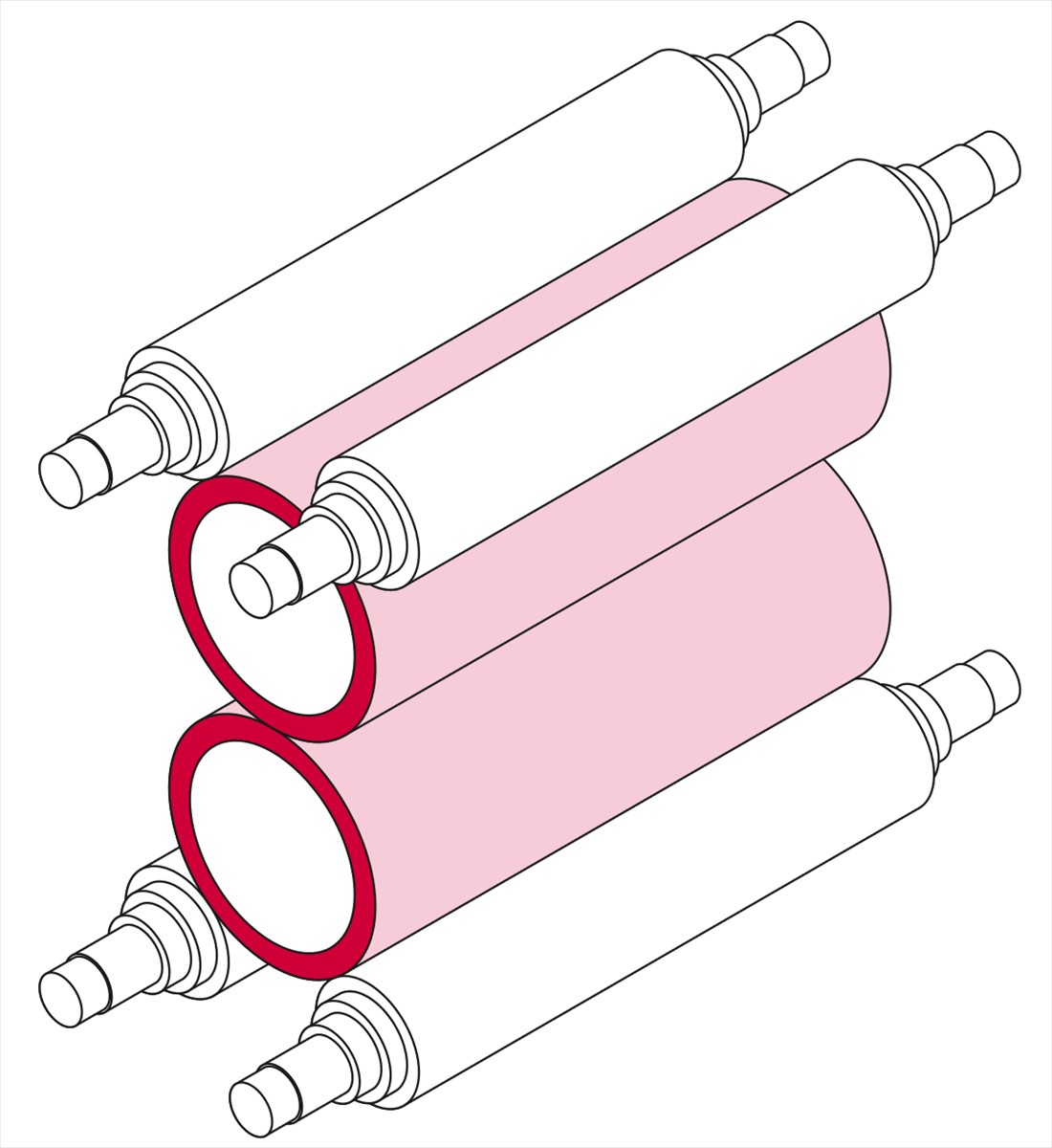
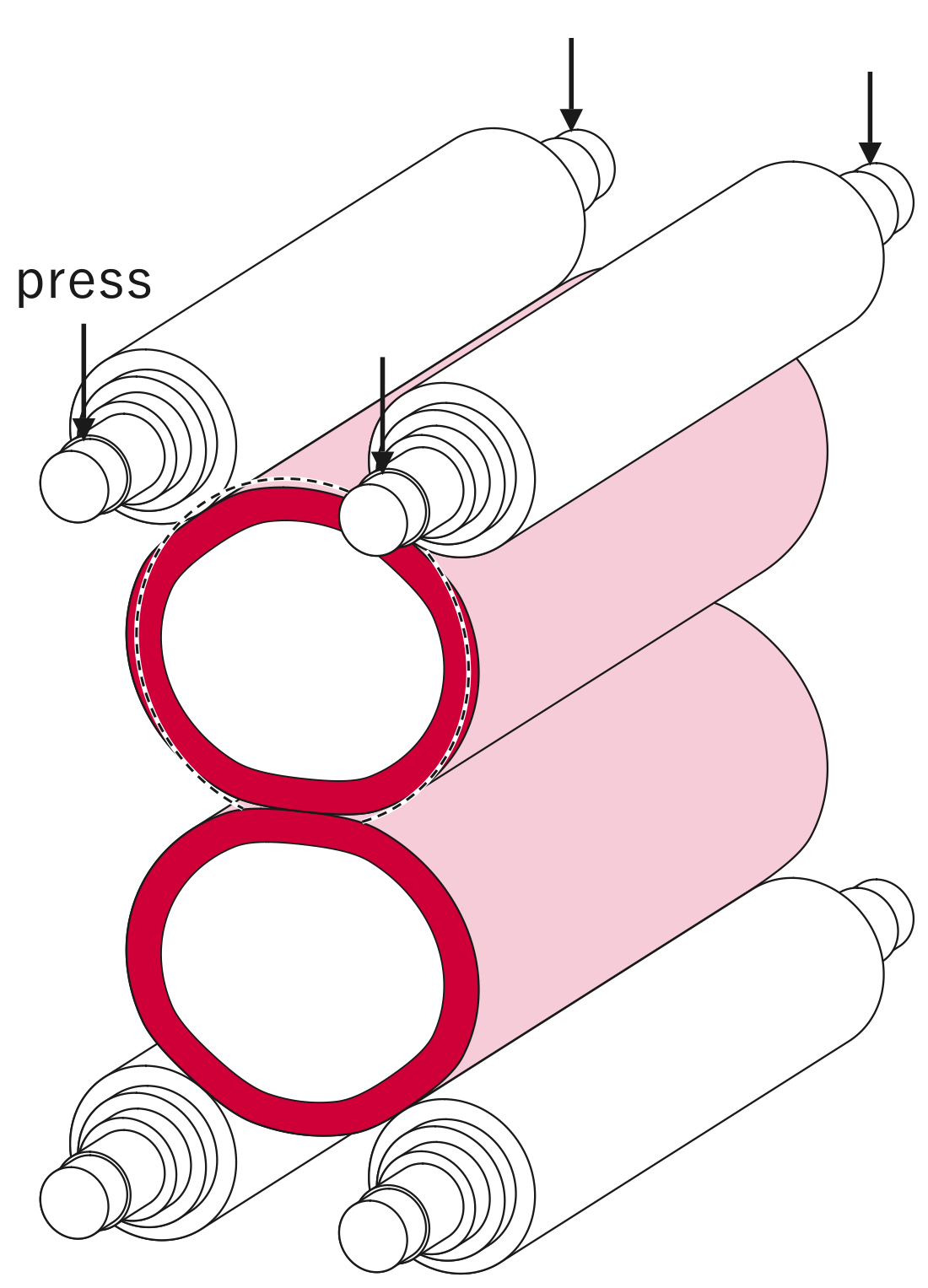
The SCCR® is a hollow press roll open at both ends. It has no journals (shaft ends), and because neither end is constrained, it deforms elastically in the radial direction all the way to the ends under load.
This widens the nip and suppresses the rise in contact pressure at the ends that tends to occur with solid rolls, equalizing contact pressure across the width (based on our analysis).
Because it can be driven by friction with the belt or by a driven backup roll, it can be used in both double belt presses and roll presses. A heating and cooling unit can be built into the space inside the roll, so it can heat and cool while pressing.
Challenges It Addresses
- With solid rolls, contact pressure rises at the ends, causing uneven results across the width
- You want to widen the nip and press uniformly across the width, even under high temperature and high pressure
- You want to heat and cool while pressing
- You are looking for a roll that can be built into the pressing section of a roll press or double belt press
Features
-
Its hollow structure, open at both ends, deforms elastically in the radial direction all the way to the ends.
It has no journals (shaft ends), and because neither end is constrained, it deforms all the way to the ends under load. The nip widens, the rise in contact pressure at the ends that tends to occur with solid rolls is suppressed, and contact pressure is equalized across the width (based on our analysis).
-
It can be used in both double belt presses and roll presses.
It can be rotated by friction with the belt or by a driven backup roll. The drive method can be chosen to suit the machine configuration.
-
It can heat and cool while pressing.
A heating and cooling unit can be built into the space inside the roll, so pressing and heating or cooling can be performed at the same time.
Contact Pressure Comparison
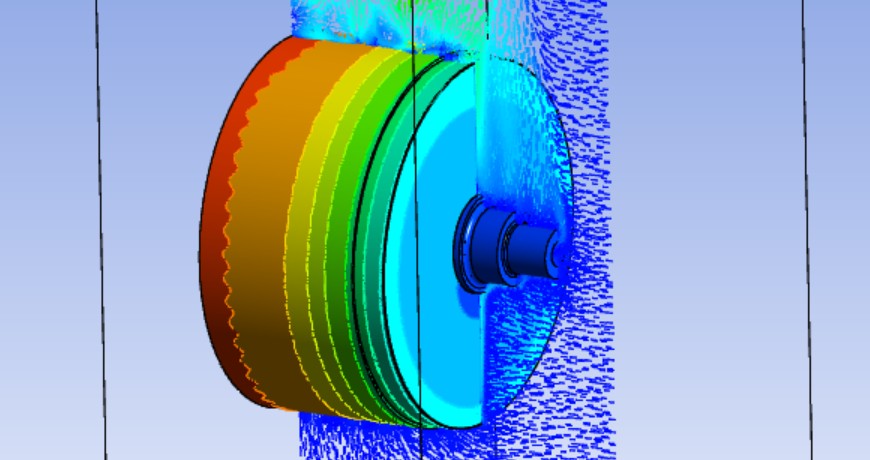
We compared the contact pressure distribution across the width for a solid roll and the SCCR® (our analysis, based on a test machine with a product width of 300 mm).
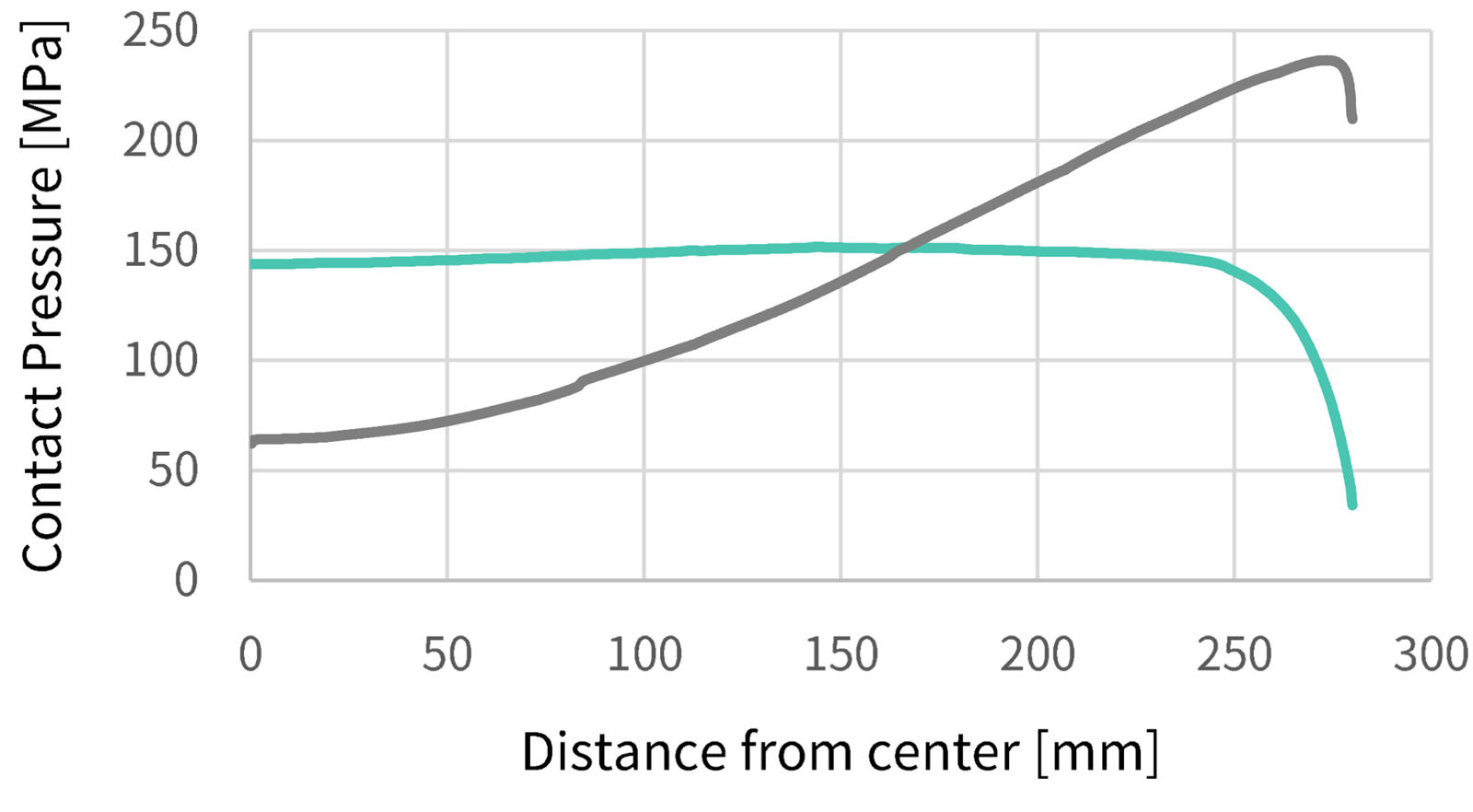
- Solid roll: contact pressure rises toward the ends
- SCCR®: almost constant up to the ends
Because the hollow SCCR® deforms radially all the way to the ends under load and the nip widens, the rise in contact pressure at the ends that tends to occur with solid rolls is suppressed.
Solid Roll

SCCR®
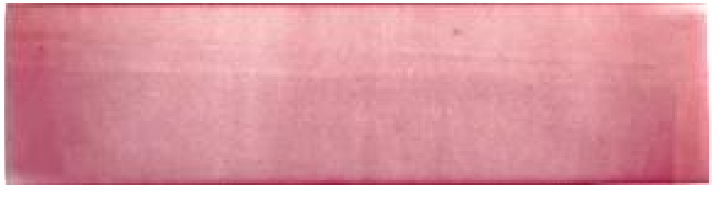
Comparison of contact pressure distribution (left: solid roll; right: SCCR®)
PerformanceTest Machine
- Pitch Line Speed
- 0.5~5m/min
- Pressurization Performance
- 300kN/m
- Product Width
- 300mm
- Heating Performance
- 300℃
The above figures are the specifications of our test machine and are not design limits. New rolls are designed to suit your needs.
Manufacturing Process
-
01
Consultation
We confirm the target material, the required load and temperature, the line speed, and the configuration of the machine the roll will be built into.
-
02
Specification Review
We work out the roll diameter, face length, drive method, whether a heating and cooling unit is needed, and the installation conditions.
-
03
Design and Quotation
We draw up specifications to suit your requirements and propose a design and quotation.
-
04
Manufacturing and Delivery
We manufacture the roll based on the design and, if required, handle installation and adjustment as well.
It is of great importance for us to maintain strong communication with our clients. We take pride in our domestic manufacturing, and we support you from careful consultation and confirmation of manufacturing conditions through to support after delivery.
FAQ
-
How is it different from a solid roll?
It has no journals (shaft ends) and has a hollow structure open at both ends. Because it deforms elastically in the radial direction all the way to the ends under load, the nip widens and contact pressure is equalized across the width (based on our analysis).
-
How is it rotated?
Because it has no journals, it is rotated by friction with the belt or by a driven backup roll. The method can be chosen to suit the machine configuration.
-
Can it heat or cool?
Yes. A heating and cooling unit can be built into the space inside the roll, so pressing and heating or cooling can be performed at the same time.
-
Are the listed figures the upper limits?
The figures listed are the specifications of our test machine, not design limits. New rolls are designed to suit your needs.
We welcome inquiries about adopting the SCCR® Uniform-Pressure Press Roll, building it into a roll press or double belt press, and more.
Providing as much of the following as you can will help us work out the specifications more efficiently.
- Target material (type, thickness, width)
- Required linear pressure and load
- Target temperature (whether heating or cooling is needed)
- Line speed
- Where it will be installed (double belt press / roll press; details of existing equipment)
Related Products
-
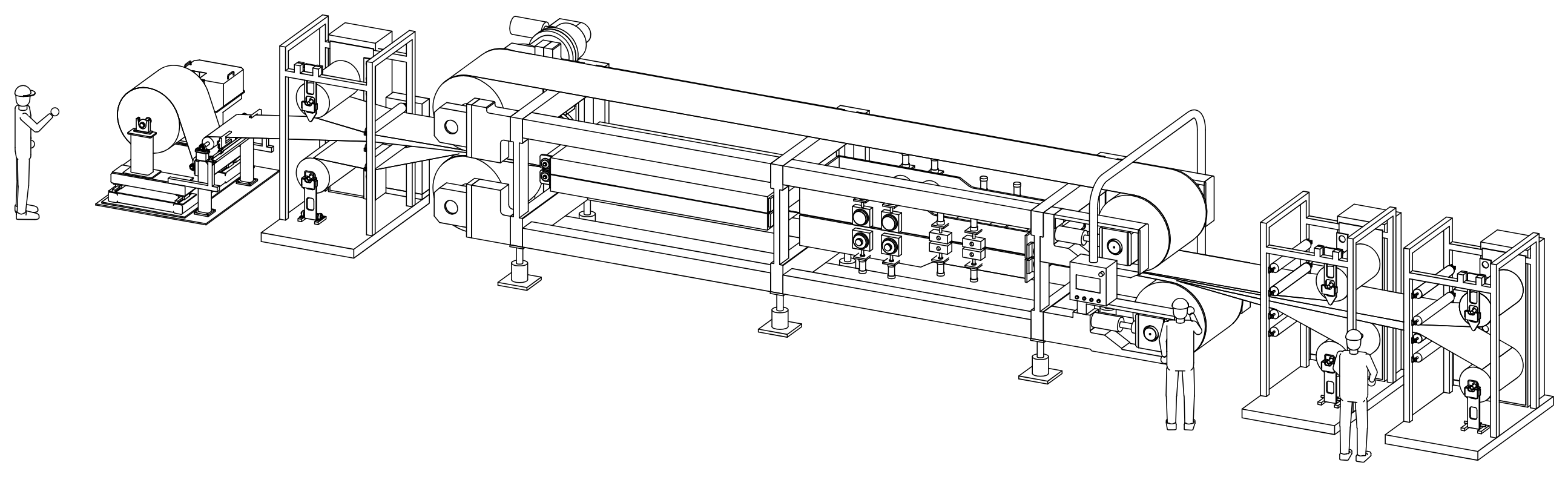 DOUBLE BELT PRESS
Double Belt Press
An Isobaric surface-pressure press system that heats and cools continuously while maintaining pressure. The SCCR® can also be built into it.
-
 HEATER ROLL
Heater Roll
For preheating, heated conveying, and temperature stabilization of films, sheets, and web materials. A heating roll designed individually for each application.